Well, I was confused about what exactly I was supposed to do for this topic. I think, I figured it out. Same saint everyone’s been using unless they cannot find any iconography on them so then you pick another.
So here we are going to transverse to Cecilia’s iconography. She is the patron St. of Music. She is usually found in art with instruments starting in the 15th century. However, there are portraits as early as the 6th century of Cecilia. They originate in Croatia and Romania. During this time period, most of the female saints were all made to look the same as you can see in the photo of the art below.
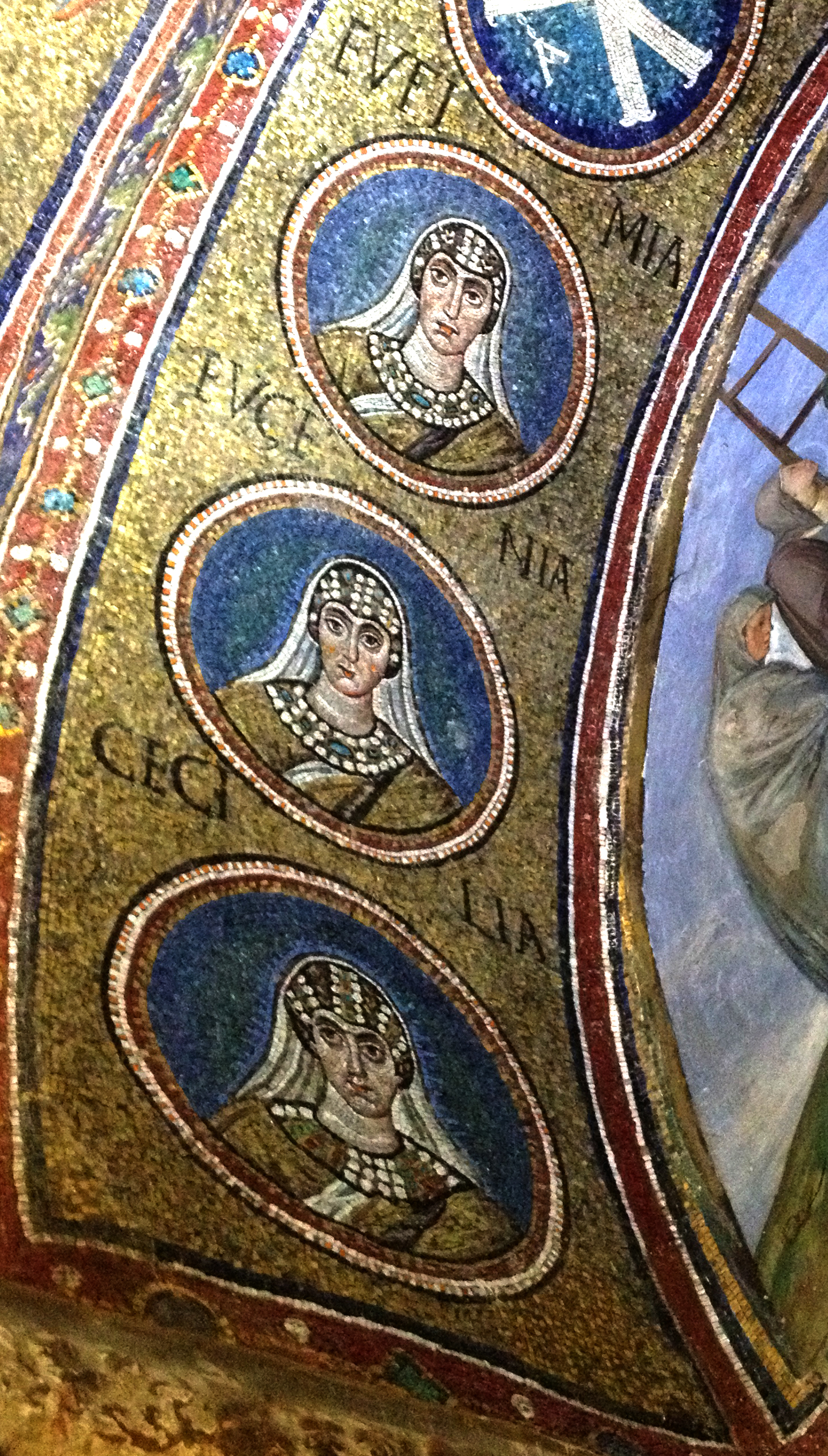
6th century
Mosaic
The Archiepiscopal Chapel, Ravenna
The only difference between the women is where their eyes are facing.
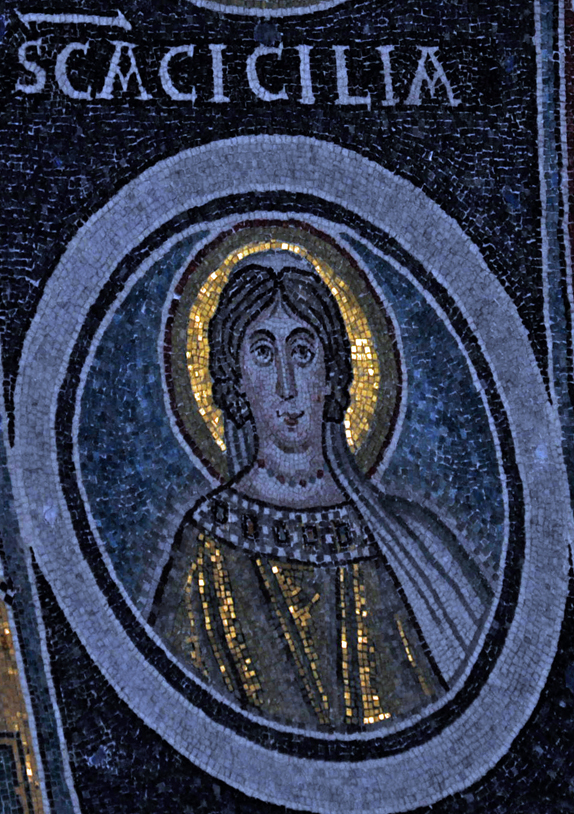
Detail: St. Cecilia
Like the other female saints in the margin of the vault, Cecilia is pictured frontally and has a halo of concentric colors. Each of the saints wears a white veil, a single-stranded necklace of dark beads, and a simple dalmatic, gold in color, with an embroidered collar.
Both of the pictures I have shown above are from around the same period the 5th century and it is noticeable in the art. They are both mosaics. There is nothing within these to show anything about her being a St. of Music. Mosaics are still popular within the 9th century.

Tempera on wood, 85 x 181 cm
Galleria degli Uffizi, Florence
On the left we see:
- Upper left: Cecilia’s wedding banquet
- Upper right: Cecilia explains to her bridegroom Valerian (red gown) about her faith and her angel
- Lower left: Cecilia with Valerian’s brother Tiburtius (white gown)
- Lower right: Cecilia teaches the brothers about the Trinity (similar hand gestures accompany explanations of the Trinity by Catherine of Alexandria and Augustine) and about Christ’s passion.
On the right the panels follow the story counterclockwise from the upper left:
- Upper left: Cecilia and the brothers (gray, white, red gowns respectively) attend at Pope Urban’s baptism of Maximus
- Lower left: Cecilia is condemned by the judge Almachius
- Lower right: The two attempts to kill her – in the burning bath, and later with a sword to the neck (middle left)
- Upper right: Still alive, Cecilia preaches to the multitudes
The artist of this piece is unknown. Speculation is made as whether he might have worked with Giotto at Assisi. The arrangement of the piece follows Sienese masters of the late 13th century.

Saint Cecilia
1514
Oil transferred from panel to canvas, 220 x 136 cm
Pinacoteca Nazionale, Bologna
At left are St. Paul (with the sword, emblem of his martyrdom) and St. John the Evangelist (before whom note the eagle, his attribute, standing on a book). At right are St. Peter (crozier, head balding from the back) and St. Mary Magdalene (holding an ointment vessel). Cecilia resides in the center.
This is an oil painting showing how art changes over time and it is one of the first pieces of art portraying her as the patron St. of Music.

The Martyrdom of St. Cecilia
15th century
Manuscript illumination
The Metropolitan Museum of Art
This Manscript illumination shows how Cecilia was attempted to be executed. She was forced to be boiled in her bath and when that did not work they tried beheading. If you remember, it took her three days to die after they had hacked at her neck to take the head off.
I do not know which manuscript this art was a part of. The art is blurry. I do not know if it was because that is the way the art was made or if the person taking the picture was shaking. I search for a better copy of the picture but was not able to find one.
Through my research, it was not until the late Middle Ages was she directly put into being associated with music. Mostly the 15th century. It is believed to be from people misreading her translatio during this time.
On a side not her name means blind… Which is interesting.
She is mostly seen with either a lute or organ. An organ is the instrument that most artists use though.

