Featured

Saints Cults Middle Ages Hist493-03

Searching for Martyrs

So I searched for martyrs. It did not really amount to much and came up with a bunch of useless information related to the topic I need to research. Also, are we allowed to research a group of martyrs or just a specific person? Does it have to specifically be a saint or just a martyr that will have a cult?

Middle Ages martyr christian cults is what I searched that pulled of the information I would need for research. https://journals.openedition.org/mefrm/1818 A journal site has relevant information and links to other sites. St. Cecilia died in the 3rd century or St. Felicita in the 2nd century. More information seems to be possible to find on St. Cecilia even though she is only a century after. This might not be the case when more research is undertaken.

St Cecilia Sites

en.wikipedia.org › wiki › Saint_Cecilia

www.catholic.org › saints › saint › saint_id=34

www.britannica.com › biography › Saint-Cecilia

www.franciscanmedia.org › saint-cecilia

www.newworldencyclopedia.org › entry › Saint_Cecilia

www.newadvent.org › Catholic Encyclopedia › C

saintsresource.com › cecilia

www.catholicireland.net › Saints of the Day › Saints

catholicsaints.info › saint-cecilia

Wiki on Cecilia

According to wikipedia, St. Cecilia was born 2nd century AD and died 176-180 or 222-235 AD which is a huge discrepancy in the date of death. She is known as the patroness of musicians. Her feast day in November 22. She could possibly be a noble lady of Rome. She was married to Valerian and supposedly had a pious romance where an angel protected her virginity. Her death date is disputed. Giovanni Battista de Rossi supports the claim she was put to death under the Roman emperor Marcus Aurelius between 176-180 AD. He bases this on the documents left behind in 600 AD by Venantius Fortunatas. This website does not have evidence to support the death in 235 however the support for the earlier death in hundreds of years following the death so that information should not be taken as hard fact either.

Catholic.org on Cecilia

4th Century a Greek religious love story of Cecilia and her husband Valerian was published. It was written on how she had remained a virgin and had taken a vow of virginity. Pope Gelasius 496AD venerated Cecilia in Rome. He is the first known to do so. A church was said to have been built over her old home. Her husband and brother in law were both martyred. She was to be suffocated in the baths. They would build a fire and she would basically sweat to death. However, it is said she did not sweat a drop. She was then supposed to be executed by ax. The executioner struck her three times and she did not die. She would die of blood loss three days later. In the time, she brought many to the lord and started a church within her home.

Conclusion

While Cecilia did in fact live, the evidence surrounding her life and death is not well documented so discerning the fact from legend could become difficult. All of the websites pretty much say the exact same thing. Each having a few different tid bits of information. It would be interesting to see the original copy of the love story between Cecilia and her husband or if there is a scanned copy of it on the internet somewhere. I am sure it is kept safe in an archive in Rome. I do not know if I will have enough primary sources to form a good research paper on the topic of Cecilia, but I think the project will focus more on the cults coming out of her martyrdom which will probably have more sources which will be researched and discovered at a later date.
Research Assignment 3.2

So this is a list of resources for Vezelay Abbey… I am just going to cite them, I might use them in my paper if I can find anything about the melting down of the chains. I am curious how that equates. It did not say a annotated bibliography and it said an example would be given but to my knowledge there never was one. So this is what I am doing for now. If it needs to be annotated, I can fix it.

O. P. “VEZELAY.” Blackfriars 27, no. 318 (1946): 328-35. Accessed May 10, 2020. http://www.jstor.org/stable/43701423.

Well, because it feels really awkward not to write something about the articles… It basically gives basic information on the Abbey and a bit about the town. It describes how the person sees it with there eyes.

Vézelay. “Déclaration Du Groupe De Vézelay.” Esprit (1940-), no. 172 (6) (1991): 206-14. Accessed May 10, 2020. http://www.jstor.org/stable/24275085.

I am no reader of French but I think this might be due to a church update on the doctrine maybe? I could be entirely wrong. Yeah. I was very very wrong. I google translated the abstract. It does have to do with some previous research of mine. The Gulf War! I love how things overlap. Anyways! On to finding another source! I don’t know though. Maybe it could be how things have changed overtime? Would it work?

Lestocquoy, J. “Vézelay.” Annales. Histoire, Sciences Sociales 7, no. 1 (1952): 65-74. Accessed May 11, 2020. http://www.jstor.org/stable/27578825.

This seems to be talking about the founding and the restoration of the abbey. It might talk about the time the Normans destroyed the church. It looks like a similar period of time. It talks about the church invasions of the Holy Lands. Meaning crusades…

Oliver, Basil. “Vézelay, a Burgundian Hilltop Town.” The Town Planning Review 9, no. 4 (1922): 251-53. Accessed May 11, 2020. http://www.jstor.org/stable/40100932.

Pictures and a little about the history of the town. It talks about the restoration of the church a bit.

“The Church of Vezelay.” The Illustrated Magazine of Art 2, no. 11 (1853): 265. Accessed May 12, 2020. http://www.jstor.org/stable/20538131.

Drawing of the abbey. It mentions how the people kept being fined for rising up against the Abbey’s heavy taxes. It also mentions that it was more of a mountain the abbey resides on not a hill and it sort of looked like a fortress. So while the church had many pilgrims is does not seem to be on good terms with people who are within its vicinity a long time.

Taylor, Michael D. “The Pentecost at Vézelay.” Gesta 19, no. 1 (1980): 9-15. Accessed May 11, 2020. doi:10.2307/766812.

Iconography of the Abbey.

BOURQUELOT, F. “OBSERVATIONS SUB L’ETABLISSEMENT DE LA COMMUNE DE VÉZELAY.” Bibliothèque De L’École Des Chartes 3 (1852): 455-71. Accessed May 11, 2020. http://www.jstor.org/stable/42994190.

I think this is the school charter I know in my earlier research it became sort of like partially a school.

Girdlestone, C. M. “THE TRADITION OF THE MARIES IN PROVENCE.” Blackfriars 32, no. 378 (1951): 407-14. Accessed May 11, 2020. http://www.jstor.org/stable/43814220.

IT shows how the cult story relates to other Mary Magdelene cult stories. However, it also shows it did not have a story right away and sort of made one up as they went.

Puglisi, Mario. Archivio Storico Italiano 78, no. 2 (298) (1920): 269-73. Accessed May 12, 2020. http://www.jstor.org/stable/44460161.

Article about an abbot at the cite. Wondering if he caused any termoil. In French, not a great read through so far.

De BASTARD, Léon. “RECHERCHES SUR L’INSURRECTION COMMUNALE DE VÉZELAY, AU XII E SIÈCLE.” Bibliothèque De L’École Des Chartes 2 (1851): 339-65. Accessed May 12, 2020. http://www.jstor.org/stable/42998124.

The uprising the townspeople caused in Vezelay. I am curious how the people actually interacted with the church there because what I have seen it is not well. So maybe just monks and travelers were really on board with the whole cult?

“THE WALSINGHAM CROSS.” Life of the Spirit (1946-1964) 2, no. 16 (1947): 167-71. Accessed May 12, 2020. http://www.jstor.org/stable/43702898.

Article on how people are still making the journey centuries after the establishment of the church. Interesting because I am pretty sure it would be hard to travel because Germany is occupying most of France to my knowledge when the person said they took their journey in 1942.

Jotischky, Andrew. “Eugenius III and the Church in the Crusader States.” In Pope Eugenius III (1145-1153): The First Cistercian Pope, edited by Jotischky Andrew and Fonnesberg-Schmidt Iben, 341-58. Amsterdam: Amsterdam University Press, 2018. Accessed May 12, 2020. doi:10.2307/j.ctvqsf3mm.19.

It shows the shift in the abbey at Vezelay. It could be a really good source depending on what angle I am looking at.

There were a variety of sources. I only looked at the English and French ones because I could sort of pick out what the French ones were saying. I think there might have been some German or Swedish ones maybe but I could not understand them at all. So, I did skip over them. They were not the main articles however. They could be important when focusing in. If so, I would take the time to attempt to read them.

Mary Magdalene: Camino de Santiago

So I searched Mary Madalene: Camino de Santiago and I came up with a lot of blogs. I guess I will just search the sight Vezeley that is mentioned in the Liber Sancti account. Can I look into the Marseille one? Anyways. This is supposed to focus on the site not the person. I will search Vezeley and see what the history behind it is.

Vezeley camino was my search term. This is what I found which is mostly again just blogs or travel websites. I will look at Vezeley Mary Magdalene next.

This pops up as Vezeley Abbey. This is probably a narrower site than the town and might be better to focus on.

Wikipedia

According to wikipedia it is a Benedictine and Cluniac monastery. Roman villa that was passed into Caroligian hands and court of Girart Roussillon. 8th century the monastaries were looted and one was burned they think by Norman raiders. I believe we touched on this in class but it was said that people said this a lot to explain things that could have just accidently occurred.

Around 1050, monks started claiming they had Mary Magdelene’s relics. Badillo or his underlings are the ones who are said to have found the holy relics in the 9th century and brought them back from the holy land. However, the story is probably made up considering they sat on the information of having her relics for a little while.

A second theory is a monk nabbed Mary Magdelene’s sarcophagus from St. Maxim in Provence and brought it back to the Abby. Apparently, slaves brought there shackles and they were melted down (actually it says freed captives) and made into iron railing around the coffin. What is the significance? I do not know but it does sound important.

Prototype of the penitent? the sorry. Romanesque architecture is one of the finest. Huguenots torched relics in 16th century. Abbot was killed because he was taxing the people to much. Patronage began to decline in late 1200 because in Provence they made the claim of having the body of Mary. The king also supported them.

1900s church about to collapse and restoration project is put underway. Carmen was the one who warned about the collapse and recommended the architect for the project.

Sort of disappointed in the overview wikipedia gave me. It is by no means perfect but it usually is not super confusing but this entry definitely was. It was jumping all over the place. I did find the melting of chains to be interesting. I could maybe research what melting of chains has to do with saints.

Other websites

Abbey related to the 2nd an 3rd crusade. St. Bernard preached there during the second and Richard the Lionheart and Phillip II Augustus left there for the 3rd one.

Sacred Destinations

Yay! Finally, I found a website that has easily readable information. I was extremely confused with what was going on. I thought I was having trouble reading for a little while there. Anyways this has some good information.

Basilique Ste-Madeleine (Basilica Church of St. Mary Magdalene) is the churches official name since I do not think I mentioned it before.

It is the largest Romanesque church in France and is only 10 yards shorter than Notre-Dame. Also, it confirms this church saw the beginning of both the 2nd and 3rd crusade.

860 A.D. is where the history of the Vezeley church began. Gerard, count of Rousaillon and his wife designated the hill for the abbey. The abbey at Cluny oversaw the abbey during its start. Eudes was the first abbot. It was thought that the first abbey at Vezeley was destroyed by Normans though the site does not specify when.

The abbey was restored in the 11th century by Abbot Geoffery and was the reason the abbey would become associated with Mary Magdelene. 1050 A.D. letter first official document showing that Mary Magdelene the saint was already a part of the abbey’s title.

First account of Magdelene’s body being taken it was taken with Maximus as well. The second tale only recounts Magdelene’s body being taken. The account of Mary’s body being there was believed for 2 centuries. Pilgrimage made the abbey powerful and well-known. Basillica began in 1096 and was dedicated in 1104. 1120 the abbey was burned down and the abbot murdered for attempting to make the townspeople pay for the construction. 12th century 3 more revolts. The church here must have been very corrupt. It seems like it is always in tumult.

1280 priest at Provence claimed to have found the true body in their church. I really don’t understand who people would believe and how it would really be proved. Is it just whoever says it loudest?

Became a collegiate church and was sacked by Huguenots and later almost fully destroyed in the French Revolution. Viollet le Duc restored the abbey in 1840.

Research 4.0

Well, I was confused about what exactly I was supposed to do for this topic. I think, I figured it out. Same saint everyone’s been using unless they cannot find any iconography on them so then you pick another.

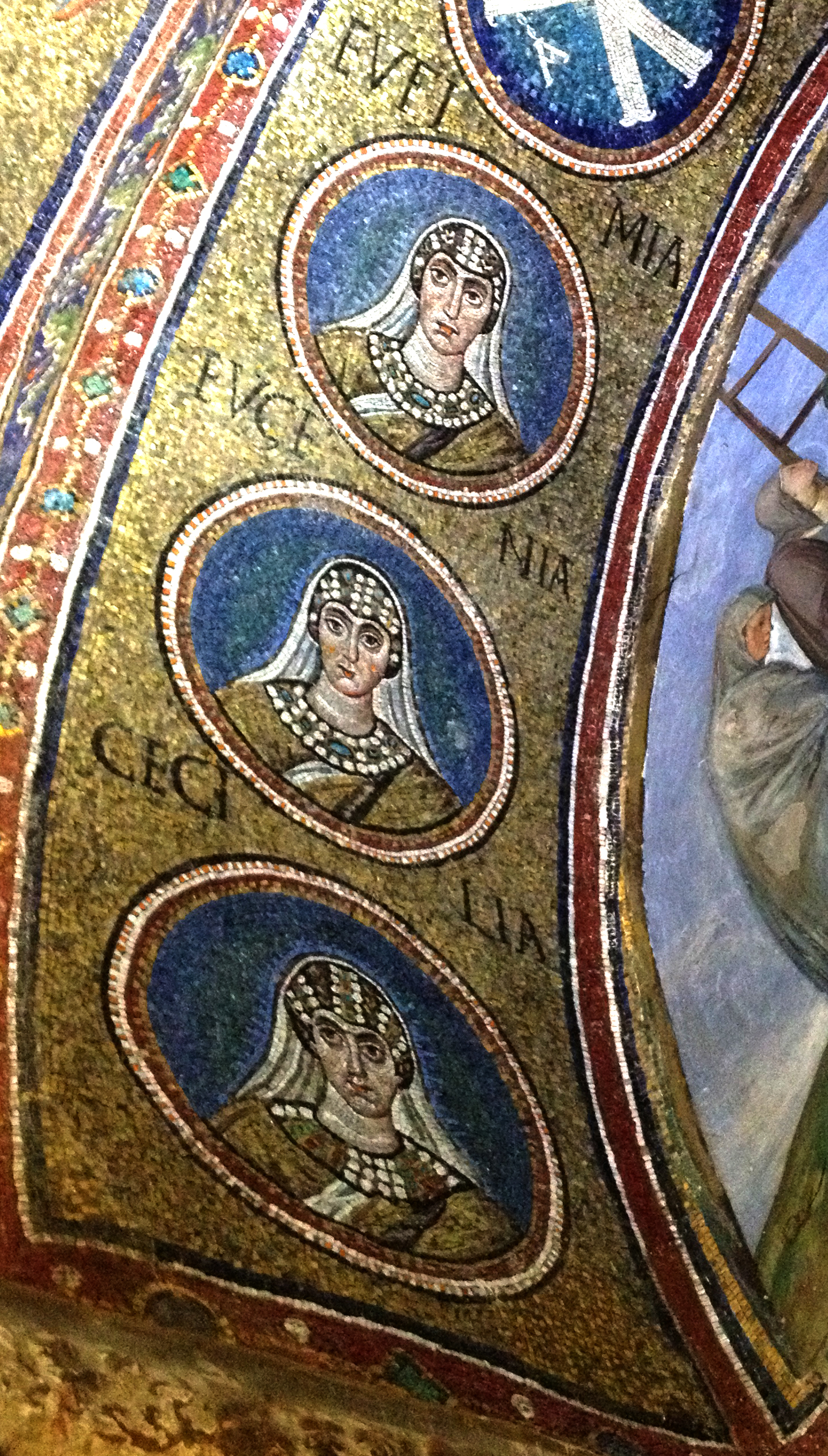
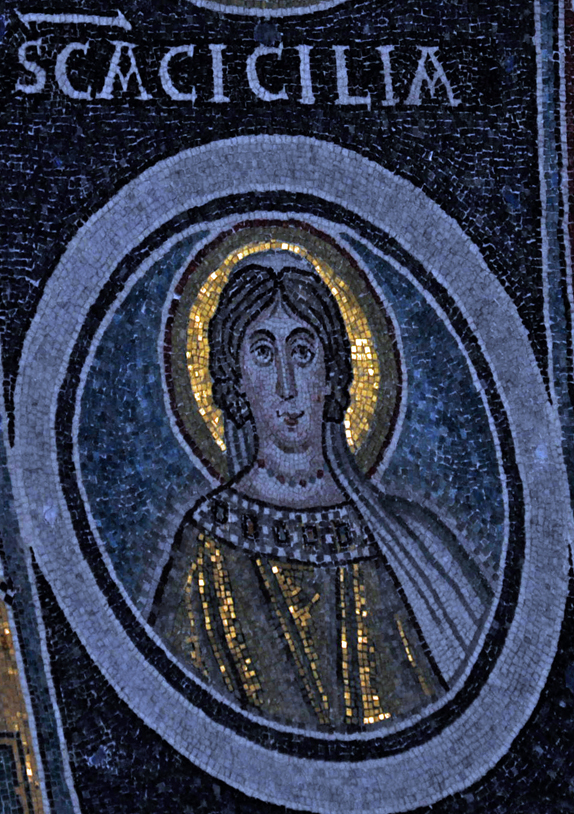
So here we are going to transverse to Cecilia’s iconography. She is the patron St. of Music. She is usually found in art with instruments starting in the 15th century. However, there are portraits as early as the 6th century of Cecilia. They originate in Croatia and Romania. During this time period, most of the female saints were all made to look the same as you can see in the photo of the art below.

Tondos of Three Saints
6th century
Mosaic
The Archiepiscopal Chapel, Ravenna

The only difference between the women is where their eyes are facing.

Apse of the Euphrasian Basilica
Detail: St. Cecilia

Like the other female saints in the margin of the vault, Cecilia is pictured frontally and has a halo of concentric colors. Each of the saints wears a white veil, a single-stranded necklace of dark beads, and a simple dalmatic, gold in color, with an embroidered collar.

Both of the pictures I have shown above are from around the same period the 5th century and it is noticeable in the art. They are both mosaics. There is nothing within these to show anything about her being a St. of Music. Mosaics are still popular within the 9th century.

Circa 1304
Tempera on wood, 85 x 181 cm
Galleria degli Uffizi, Florence

On the left we see:

  • Upper left: Cecilia’s wedding banquet
  • Upper right: Cecilia explains to her bridegroom Valerian (red gown) about her faith and her angel
  • Lower left: Cecilia with Valerian’s brother Tiburtius (white gown)
  • Lower right: Cecilia teaches the brothers about the Trinity (similar hand gestures accompany explanations of the Trinity by Catherine of Alexandria and Augustine) and about Christ’s passion.

On the right the panels follow the story counterclockwise from the upper left:

  • Upper left: Cecilia and the brothers (gray, white, red gowns respectively) attend at Pope Urban’s baptism of Maximus
  • Lower left: Cecilia is condemned by the judge Almachius
  • Lower right: The two attempts to kill her – in the burning bath, and later with a sword to the neck (middle left)
  • Upper right: Still alive, Cecilia preaches to the multitudes

The artist of this piece is unknown. Speculation is made as whether he might have worked with Giotto at Assisi. The arrangement of the piece follows Sienese masters of the late 13th century.

Raffaello Sanzio
Saint Cecilia
1514
Oil transferred from panel to canvas, 220 x 136 cm
Pinacoteca Nazionale, Bologna

At left are St. Paul (with the sword, emblem of his martyrdom) and St. John the Evangelist (before whom note the eagle, his attribute, standing on a book). At right are St. Peter (crozier, head balding from the back) and St. Mary Magdalene (holding an ointment vessel). Cecilia resides in the center.

This is an oil painting showing how art changes over time and it is one of the first pieces of art portraying her as the patron St. of Music.

The Limbourg Brothers
The Martyrdom of St. Cecilia
15th century
Manuscript illumination
The Metropolitan Museum of Art

This Manscript illumination shows how Cecilia was attempted to be executed. She was forced to be boiled in her bath and when that did not work they tried beheading. If you remember, it took her three days to die after they had hacked at her neck to take the head off.

I do not know which manuscript this art was a part of. The art is blurry. I do not know if it was because that is the way the art was made or if the person taking the picture was shaking. I search for a better copy of the picture but was not able to find one.

Through my research, it was not until the late Middle Ages was she directly put into being associated with music. Mostly the 15th century. It is believed to be from people misreading her translatio during this time.

On a side not her name means blind… Which is interesting.

She is mostly seen with either a lute or organ. An organ is the instrument that most artists use though.

St. Cecilia Bibliography

So, I am going to probably write a biography and maybe explain the sources a little. I am not sure exactly what I am supposed to do considering it only said soures.

Source 1

Lapidge the Roman Martyrs, translation and commentary pp. 68-88 https://moodle.leeuniversity.edu/pluginfile.php/1783592/mod_resource/content/1/The%20Roman%20Martyrs_%20Introduction%2C%20Translations%2C%20and%20Commentary.pdf

Composed Arnobius the Younger c450. This leads Lapidge to believe that the Caecilia story is fictional and her martyrdom did not occur. Also, there is no reference to which Roman King she was killed under which is always mentioned in hagiographies so people know what time period it is at the very beginning.

Source 2

Searched for St. Cecilia on Jstor. Then narrowed it to Classical Studies. 288 results popped up.

“The Lord Wemyss “St. Cecilia” by Desiderio Comes to Toledo.” American Journal of Archaeology 43, no. 2 (1939): 202-03. Accessed February 11, 2020. doi:10.2307/499259.

This source is just talking about Desiderio da Settignano artwork of St. Cecilia

Notes

There are a lot of mentions of St. Cecilia festival in sources.

Source 3

White, Bryan. “Provincial Celebrations of St Cecilia’s Day.” In Music for St Cecilia’s Day: From Purcell to Handel, 219-307. Boydell and Brewer, 2019. Accessed February 11, 2020. http://www.jstor.org/stable/j.ctv6jmtw4.12.

Celebrations involving music. Called St. Cecilia Day. Cecilia was a musical st.

Source 4

Luckett, Richard. “St. Cecilia and Music.” Proceedings of the Royal Musical Association 99 (1972): 15-30. Accessed February 11, 2020. http://www.jstor.org/stable/766152.

Cecilia is spelled Cecily. Shows how music came into her story. Follows the main story.

Source 5

Benson, C. David. “Statues, Bodies, and Souls: St. Cecilia and Some Medieval Attitudes toward Ancient Rome.” In Medieval Women and Their Objects, edited by Adams Jenny and Bradbury Nancy Mason, 267-88. Ann Arbor: University of Michigan Press, 2017. Accessed February 11, 2020. http://www.jstor.org/stable/10.3998/mpub.9222733.16.

It talks about some artifacts found.

Source 6

Carroll, Warren H. 1984. “The Reality of St. Cecilia: An Historical Note.” Faith & Reason 10: 36–43. http://search.ebscohost.com/login.aspx?direct=true&AuthType=sso&db=rfh&AN=CPLI0000119924.

The history of St. Cecilia. I hope it will be helpful. Requested it through interlibrary loan.

Source 7

Journal Modern Language Notes, volume 68, no.3., 1953., G.H. Gerould.

I don’t know if I will be able to find it considering it was published such a long time ago

Source 8

Connolly, Thomas H.

The Legend of St. Cecilia, Volume I: The Origins of the Cult, and Volume II: Music and the Symbols of Virginity. Complete in Two Volumes

Possible book on St. Cecilia and how the cult began.

Source 9

Reames, Sherry L. 1991. “Mouvance and Interpretation in Late-Medieval Latin: The Legend of St Cecilia in British Breviaries.” In Medieval Literature: Texts and Interpretation, 159–89. Binghamton, NY. http://search.ebscohost.com/login.aspx?direct=true&AuthType=sso&db=rfh&AN=ATLA0001178497

Hopefully, it will have interpretations of the earlier latin texts on St. Cecilia.

Source 10

Medieval Literature: Texts and Interpretation. 1991. Medieval & Renaissance Texts & Studies (Series) 79. Binghamton, NY: Ctr for Medieval & Early Renaissance St, SUNY. http://search.ebscohost.com/login.aspx?direct=true&AuthType=sso&db=rfh&AN=ATLA0001040918.

Another Medieval study.

Conclusion

It was honestly hard to find second hand sources. I do not even know how helpful the ones I found will be. I probably need to search a different way. There is a lot of information on St. Cecilia celebrations in the 1600s. The books might bring more insight. It was frustrating because many of the articles were not available to be read so you could not tell how useful they would be to research.

Bibliotheca Hagiographica Latina on Cecilia

Introduction

Hi Guys! This week I am looking at the Bibliotheca Hagiographica Latina to explore Cecilia more in depth. I am attempting to look for more sources on her. Last week I ran into trouble with the Acta Sanctorum but this weeks seems to be looking up. The link for the website is http://bhlms.fltr.ucl.ac.be/ if you wish to carry out your own research. I searched Caecilia because that is the Latin spelling in the Identifier search. The texts I found on the website are below.

The Texts by Identifier

  • Inc. prol.: Humanas laudes et mortalium (mortales) infulas — Inc.: Huius vocem audiens Caecilia virgo clarissima absconditum semper evangelium Christi gerebat in pectore; 1495
  • Non raro, om. vix non toto prologo, libellus inc.: Omnibus patent Christi vestigia… — Inc.: Huius vocem audiens Caecilia virgo clarissima absconditum semper evangelium Christi gerebat in pectore; 1495a
  • Inc.: S. Caecilia virgo castissima absconditum semper evangelium Christi tenebat in pectore suo; 1496
  • Inc. prol.: Cum multorum martyrum confessorumque vitas — Inc.: Caecilia civis romana nobili genere nata; 1496d
  • Inc.: Porro Caeciliae vivacem condere laudem; 1497
  • *Inc. prol.: Poscis, magnifica mater… Caecilia — Inc.: Itaque b. Romaricus nobilis in palatio; 7322
  • *Inc.: Cum b. Tiburtius per praedicationem bb. Caeciliae in Dominum N.I.C. credidisset, dixit fratri suo: Miserere mei…; 8482
  • *Inc.: Tiburtius et Valerianus sponsus b. Caeciliae … ad haec cottidie vacabant…; 8483b
  • *Inc.: Beatissimi martyres Christi Tiburtius et Valerianus, dum per exhortationem s. Caeciliae errorem gentilitatis; 8486h
  • *Entries that are starred are referring to another Caecilia not the woman I am researching.

I included both the incipit and the BHL code from the website. The website provided the dossier and titre as well but I did not include those items here. The BHL website showed nine different entries. Hopefully, they will prove to be useful. However, I do not know if some of them might refer to a different Cecilia. Why don’t we find out!?

Texts by Build the hagiographic record of a saint

When Caecilia was searched records for two saints came up. They show the Saints feast days and Caecilia was the first entry for Nov 22. There are 12 entries. Seven of the texts did not show up on my original search and the last four on the previous list did not come up on the list for this Caecilia so they must belong to the other with the same name. I will star the ones that are not relevant to my research. The list below is what popped up when I searched my Caecilia. I left out the ones I had in the previous list.

  • 1498: Carmen auct. FLodoardo
  • 1499: Translatio (littera spuria Paschalis I papae)
  • 1499a: Translatio (littera spuria Paschalis I papae)
  • 1499b: Translatio (littera spuria Paschalis I papae)
  • 1499c: Translatio (littera spuria Paschalis I papae)
  • 1500: Translatio (littera spuria Paschalis I papae
  • Caeclia: Textus (sn)

I will now search under each on the list to find the incipit. Folder, title, incipit, and desinit is given. I will only publish the incipit below in same order as the list directly above.

  • Inc .: Urbanus validi robusta iura Calisti
  • Inc .: Cum summae apostolicae dignitatis apex … Ad hoc debita nos
  • Inc.: Cum summae apostolicae dignitatis apex… Ad hoc debita nos
  • Inc.: Cum summae apostolicae dignitatis apex… Ad hoc debita nos
  • Inc.: Cum summae apostolicae dignitatis apex… Ad hoc debita nos
  • Inc.: Cum summae apostolicae dignitatis apex… Ad hoc et iniuncta nobis
  • *The last entry did not show anything other than dossier. It must just be the holder for all the other folder with information.

When looking at the previous list and this list there seems to be a total of 7 different sources. Let’s google the sources.

Google our Friend

Mirabele in an Italian website that seems to be a archival database containing hagiographic information on the saints. However, it does not give the documents just where they are stored. I do not think I will be able to view the documents. It mentions those that might be a part of Cecilia’s story but they are not sure. When looking up the first text it associated it with chants of saint Cecilia’s cults if I am correct. The first entry is a hymn if I researched correctly.

St. Cecilia Take II

The next step in the research was to look at the Acta Sanctorum. I used the Documenta Catholica Omnia website to read Cecilia’s entry. Her feast day is on November 22 so I opened the last entry available on the site. http://www.documentacatholicaomnia.eu/

Cecilia wanted to remain hidden. Then, I realized as I looked through the very long index her name still was not there. I forgot I was reading a Latin document and in Latin her name was probably spelled differently hence the trouble finding her entry. I checked google for the Latin version of Cecilia. In Latin, her name is Caecilia which with a long index put it in a very different place. Once, I did this finding her name in the entries was easy. Caecilia hortulana de littore S. Erasmi 304a was the entry. Cecilia gardener of the beach of Saint Erasmi? Is what I think it would translate as. I do not know who or what Erasmi is. I searched and could not find anything.

Entry in Acta Sanctorum

“Accedens ad beati Gratiae sepulchrum Caecilia hortulana de littore S. Erasmi, cotidiana diutinaque febri afflicta, dum supplex pro sanitate orat, confestim ex febre perfecte convaluit, parque incolumitatis beneficium accepit Angelus Bertini, piscator Murianensis, qui, maligna oppressus febri, dum in extremo anhelitu luctatur, per beati Gratiae imploratam opem sanitatem recipit.”

Her entry is extremely small and not bold at all. I could not find another entry within November for her. I looked to see if there had ever been a change in her feast day and I could not find it. Why does everyone else seem to have larger entries?

November only had one section within the month while the others had multiple. The last day in the entries seemed to be the ninth. I do not believe the ones accessed for free online can be used to research my saint. I could be incorrect.

Design a site like this with WordPress.com
Get started